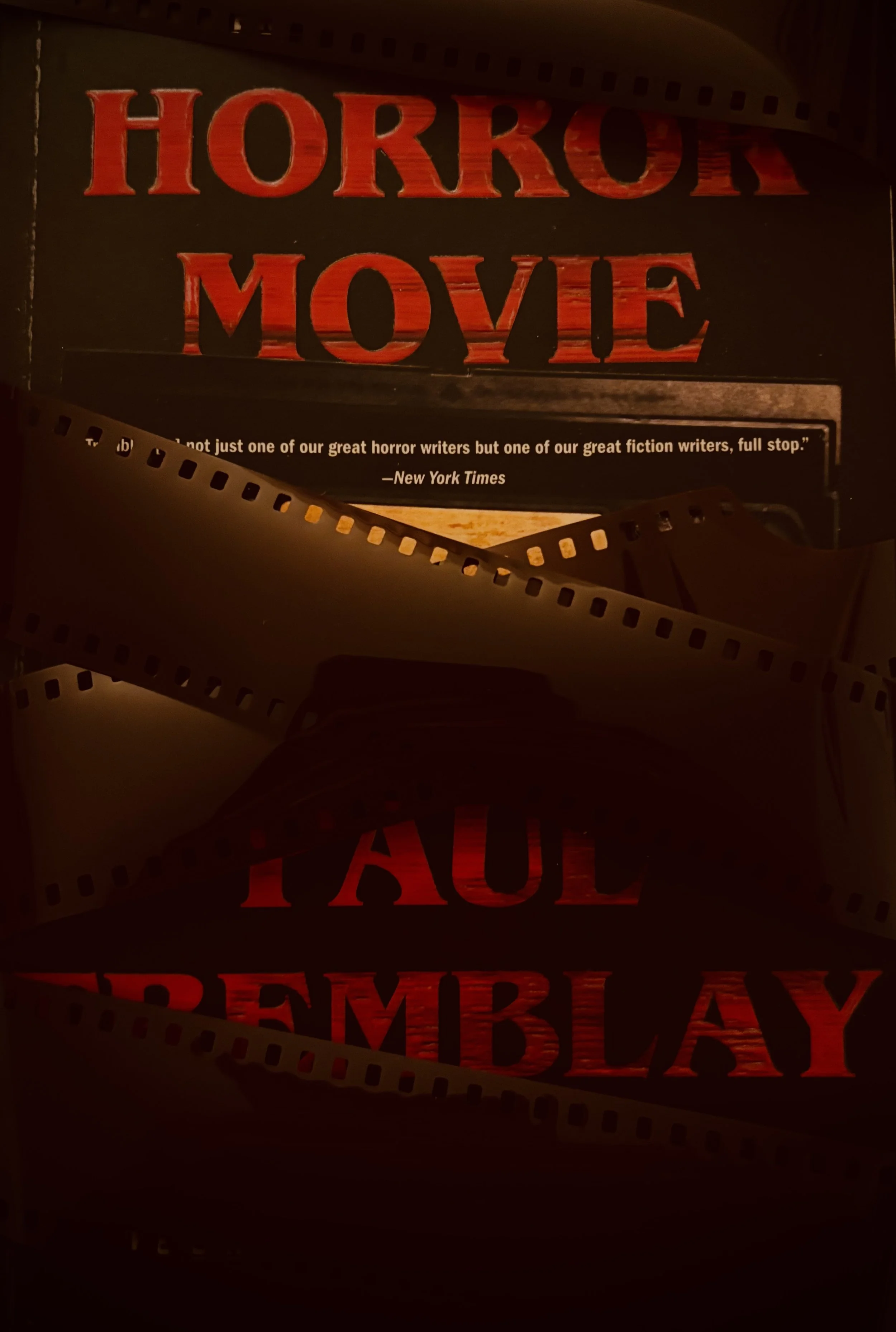
Horror Movie, by Paul Tremblay, 2024 William Morrow
If horror success is measured by the sum of visceral reactions, shock value, and level of need to turn to the next page, Paul Tremblay’s 2024 novel Horror Movie is a dynamic success that overloads in all categories. It’s a heavyweight work that paces its punches to build suspense and delivers the unexpected knockout in the final seconds, a shot we didn’t know we wanted until it wrecks the equilibrium we fought so hard to maintain through its paces.
The plot is a simple cliche horror trope already explored ad nauseam, but cliche is not an inherently negative connotation. Peter Straub (whose memory this novel is dedicated to) wrote an entire novel titled Ghost Story, and it’s one of the most atypical narratives one can read in the genre. Straub would be proud of where Tremblay took this one. Young, aspiring film auteurs Victoria and Cleo recruit our nameless narrator to inhabit the lead role of “Thin Kid” in their indie horror film they’ve received modest funding to produce. And while the filming was completed, the movie was never released, except for Valentina’s 2008 online posting of footage and the original screenplay. The narrative then shifts to and fro from on set in 1993, to the Thin Kid’s present adulthood and his entanglement, as the only surviving member of the core cast and crew, in the film’s push for transcendence from horror film conspiracy lore to its full revival for the masses. As with a worn VHS from the 90s, we rewind and fast-forward from then to now, pausing for piece-mealed excerpts of the film’s screenplay. All the while, we are privy to the Thin Kid’s real-time reactions from behind his mask, and his reflections years later on what was occurring on set and how it all ended.
Implicit/Explicit Content
Tremblay says “fuck that” to the either/or trend in horror to be either academic or overbearing with depictions of the absurd, disturbing, or grotesque. He says let’s do both. His readers stagger between “tell me more!” to “Stop! I don’t want to know.” This narrative whiplash makes every scene a shock delight (insert box of chocolates analogy to bring it back to 90s film). He never lets us get settled, but why would we want to? We are horror readers, after all. For me, there were several scenes I read pacing around my room with a clenched fist and holding the book at a weird angle, like I couldn't bear looking directly at what I was reading. Success!
Lost Analog Love
Underneath the horror mask, this novel is a lost love story. The love we abandoned is the raw, analog way we produced art in past lives. On the path to digital we lost the tactile feel of production. As difficult and catastrophic as the 1993 filming was for the Thin Kid, he speaks with reverence about the smell of the chainsaw oil and actual cigarette smoke used in the film, the feel of the old latex mask he is forced to inhabit, and the way (fake?) blood feels on his skin after shooting. For the $25 million the film’s reboot receives, he knows the old ways of making this work of art aren’t returning. Most of us who lived through these past eras at the very least have a subconscious understanding that something pure has been replaced. And as close as digital replications can come, they will always be synthetic reproductions. Personally, I love how my Digital SLR has made me a better photographer. I will always remember however, the way 35 mm film smells, and the anticipation of not knowing if I got the perfect shot until that film was developed. Rest in peace to the artistic methods of our past lives.
Speaking of Past Lives
Tremblay’s Thin Kid, even when narrating the pain, sleeplessness, fear, and physical abuse of the shooting of Horror Movie, never denies that those five weeks were infused in magic, and the most important of his life. Everything after never compares, even if everything after never cuts (literally/figurately) as deep. We don’t gather around to hear each other’s stories of the calm, steady, and comfortable times of our lives. We want to tell of the times we made it through and how it transformed us. The worst times are the best stories, and the most terrifying moments are the best scenes. So writers don’t allow all characters to be martyrs. Someone has to be left to tell us all about the evil, the darkness, the monsters still out there, and not just in the past tense.
Fill in the Blank
Tremblay severs a nerve when, in the script for Horror Movie’s penultimate scene, Valentina and Cleo toy with their audience further than they believe the audience can bear. To not reveal their methods here, it will suffice to say they interminably delay an inevitable horror to imagine how you, the audience, will handle it. How we react in the void where our expectations are subverted, with anger, anxiety, confusion, or boredom, says everything about who we are. From the myriad of reactions the script suggests, I am among the fragments of the collective that “attempt to analyze the image: the empty archway, the expanse of the room between the archway and the viewer, the dim light on the other end, the pool of darkness from which we stare. Some of us attach meaning and metaphor…” Too many undergraduate essays in English literature ingrain this default defense mechanism.
Rip Them to Shreds
What we believe to be Horror Movie’s ending gives us one last descent into the trenches of shock and gore. We’re spent and satisfied, although we aren’t certain if we were devouring this book or if we were the prey. We don’t have time to decide which before Tremblay drags us into sudden-death overtime. And then we know we’re the ones being consumed. Our expectations aren’t subverted, but ripped to fucking shreds.